Manage business trips on one connected platform
SAP Concur solutions use embedded AI to help travel leaders improve travel and expense management through increased policy compliance, greater visibility into spending, and enhanced traveler safety.


Why corporate travel management needs a connected approach
Modern business travel management requires more than booking tools. Travel programs need visibility into spend, stronger policy compliance, support for duty of care, and a better traveler experience. As traveler expectations evolve and disruptions become more common, disconnected systems make it harder to manage risk, control costs, and measure travel program ROI.
A connected travel and expense management solution helps organizations bring travel booking, expense reporting, policy enforcement, and travel data together in one platform, making it easier to manage business travel effectively.

How to drive safer, smarter, and more cost-effective business travel
Today’s travel leaders oversee far more than booking and expense reporting. They are responsible for traveler safety, policy compliance, supplier strategy, sustainability goals, cost control, and more. As organizations look for greater visibility into spending and stronger ROI, integrated travel and expense management technology has become essential for managing modern business travel programs effectively.

Why choose SAP Concur for corporate travel management
Corporate travel programs face growing pressure to reduce costs, improve compliance, support traveler safety, and deliver a seamless booking experience. Here’s how SAP Concur solutions can help organizations achieve these goals.




How Campari improved travel management with Concur Travel
Campari Group sought to improve traveler safety, strengthen duty of care, and create a more connected business travel management program. By implementing Concur Travel, the company gained better visibility into travel activity while supporting travelers wherever business takes them.
“Our mission is to streamline the travel experience, guarantee safety and security for employees while fostering a sustainable travel culture,” said William Cocco, global travel manager at Campari Group. “With Concur, we are able to integrate partners that help us with the duty of care to offer travelers all the tools to travel safely.”

Resources for modern travel management
Explore guides, templates, research, and travel management best practices designed to help travel managers improve compliance, increase visibility into travel spending, reduce costs, and optimize corporate travel programs.




Connect your travel & expense solutions
The most effective corporate travel management programs connect travel booking, expense management, traveler safety, payment solutions, supplier content, and reporting into a single ecosystem.




AI-powered corporate T&E management by SAP Concur and Amex GBT
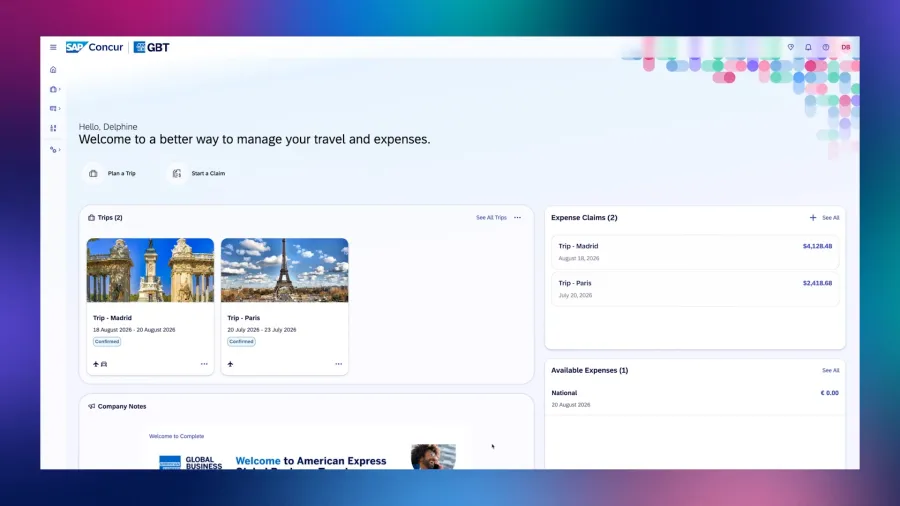
Complete by SAP Concur and Amex GBT combines the power of Concur and Amex GBT in one AI-powered platform, uniting travel booking, traveler services, and expense management end to end. The result is full visibility into every trip and dollar spent, stronger policy alignment, and a travel program built to perform at every stage of the journey.
See Concur Travel in action
See how SAP Concur solutions help organizations manage business travel, improve compliance, and increase travel program visibility.


FAQs about corporate travel management
Corporate travel management is the process of planning, booking, tracking, and optimizing business travel for employees. It includes managing travel policies, expenses, supplier relationships, traveler safety, and reporting.
Effective travel management is important because it helps organizations control costs, improve employee experience, maintain compliance with company policies, and ensure traveler safety. It also provides visibility into travel spending, enabling better budgeting and strategic decision-making.
A business travel manager oversees an organization’s travel program to ensure employees can travel efficiently, safely, and cost-effectively. Their responsibilities often include:
- Developing and enforcing travel policies
- Managing travel budgets and controlling costs
- Negotiating rates with airlines, hotels, and other suppliers
- Monitoring traveler safety and risk management
- Analyzing travel data and reporting on spending trends
- Supporting employees with travel planning and issue resolution
- Evaluating and implementing travel technology and booking tools
Their goal is to balance business objectives, traveler satisfaction, and financial efficiency.
Businesses can manage travel effectively by:
- Creating a clear travel policy that outlines booking procedures, spending limits, and approval processes
- Using a centralized booking and expense management platform
- Tracking travel spend and analyzing data regularly
- Negotiating preferred rates with airlines, hotels, and transportation providers
- Prioritizing traveler safety and duty of care
- Encouraging advance bookings to secure better rates
- Automating approvals, reporting, and expense reconciliation
- Reviewing travel performance regularly and adjusting strategies as business needs change
A well-managed travel program reduces costs, improves compliance, and delivers a better experience for employees on the road.
A corporate travel management program helps organizations control travel spending, streamline booking and expense processes, and improve the overall traveler experience. It provides greater visibility into travel activity, supports policy compliance, and enables businesses to make data-driven decisions about travel spending. A well-managed program can also strengthen traveler safety and reduce administrative workload for employees and finance teams.
Business travel management reduces costs by creating clear travel policies, encouraging the use of preferred suppliers, and providing visibility into travel spending. Companies can secure negotiated rates with airlines, hotels, and car rental providers while using data and reporting tools to identify savings opportunities. Centralized booking and expense management also help prevent overspending and improve budget control.
A corporate travel policy is a set of guidelines that outlines how employees should book, manage, and expense business travel. It typically covers approved booking channels, spending limits, reimbursement rules, and traveler responsibilities. A clear travel policy helps organizations maintain compliance, control costs, ensure fairness across the workforce, and support employee safety while traveling.
Businesses should look for a travel management solution that is easy to use, supports policy compliance, provides real-time reporting, and integrates with existing expense and finance systems. Key features may include centralized booking, automated approvals, expense management, traveler tracking, and access to customer support. The right solution should help reduce administrative effort, improve visibility into travel spending, and create a better experience for both travelers and travel leaders.
Companies can improve traveler safety and fulfill their duty of care responsibilities by implementing clear travel policies, providing employees with approved booking tools, and maintaining visibility into traveler locations. Many organizations also use risk monitoring, emergency communication systems, and traveler support services to respond quickly to disruptions, health concerns, or security incidents. A proactive approach helps employees feel supported while reducing risk for both travelers and the business.
A company should consider outsourcing travel management when travel volume increases, administrative tasks become difficult to manage internally, or greater expertise is needed to optimize travel spending. Outsourcing can provide access to professional travel support, negotiated supplier rates, specialized technology, and traveler assistance services. For many organizations, it allows internal teams to focus on strategic priorities while improving efficiency and traveler satisfaction.
Technology plays a central role in modern corporate travel management by simplifying booking, expense reporting, policy enforcement, and travel tracking. Travel management platforms help employees book approved travel options, automate workflows, and provide real-time visibility into travel activity and spending. By centralizing travel data and processes, technology helps organizations improve compliance, reduce administrative work, make informed decisions, and deliver a better travel experience.
Travel leaders must balance cost control, travel policy compliance, traveler safety, sustainability goals, reporting requirements, and employee expectations. Many organizations also struggle with fragmented booking channels, limited visibility into travel spend, and increasing pressure to demonstrate travel program ROI.
Travel leaders can improve visibility by using integrated travel and expense management software that brings booking, spending, reimbursement, and reporting data together in a single platform. Better visibility helps organizations identify savings opportunities, improve compliance, and optimize travel programs.
Travel policy compliance is the extent to which employees follow an organization’s established travel guidelines when booking, managing, and expensing business travel. This includes using approved booking channels, selecting preferred suppliers, staying within spending limits, and adhering to reimbursement requirements.
Strong travel policy compliance helps businesses control costs, improve budget visibility, support traveler safety, and ensure travel spending aligns with company objectives. It also reduces administrative challenges and makes it easier to track and manage travel expenses across the organization.
Travel leaders can improve travel program ROI by balancing cost control with traveler productivity and satisfaction. This includes negotiating preferred supplier rates, increasing travel policy compliance, using technology to automate processes, and analyzing travel data to identify savings opportunities.
Travel leaders can also maximize ROI by streamlining booking and expense management, reducing administrative workloads, improving traveler safety, and ensuring employees have access to the tools and support they need to travel efficiently. A successful travel program delivers measurable value through lower costs, better operational efficiency, and a stronger traveler experience.